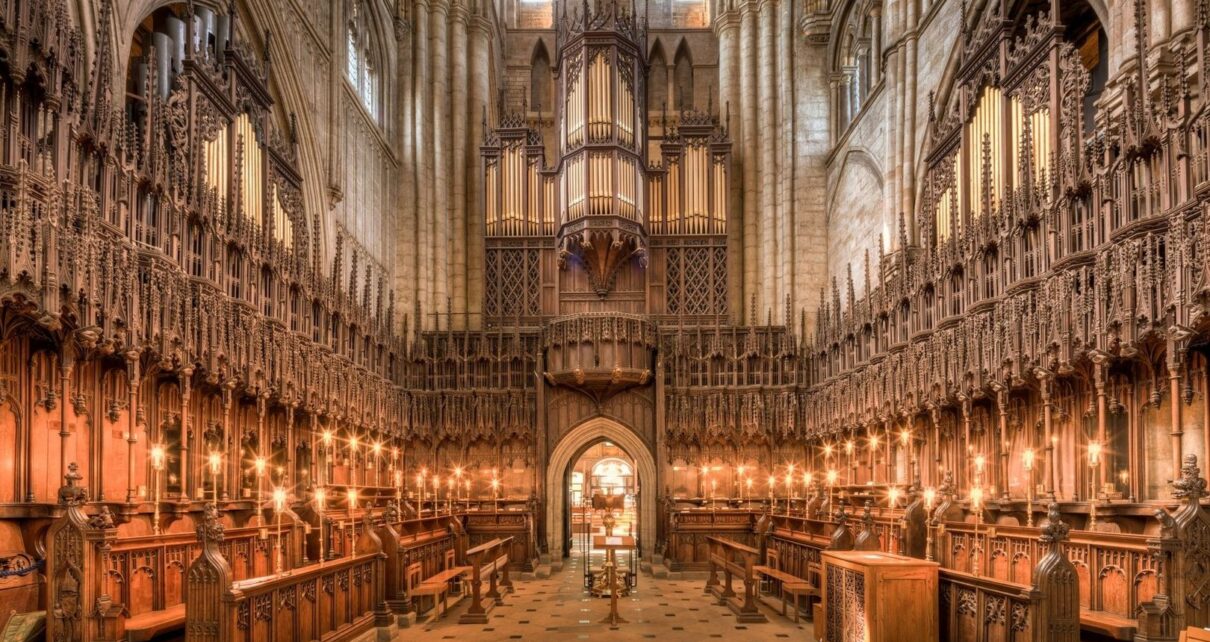
Entering the Sonic Engine of the Medieval Cathedral
Approach a medieval cathedral as more than a stone monument and its design begins to read like an acoustic system. The nave, vaults, columns, transepts, galleries, and wall surfaces do not merely contain worship. They shape what can be heard, how quickly words can be delivered, and which combinations of voices remain intelligible. For singers, conductors, and listeners, the building is part of the instrument.
In a large masonry interior, a vocal sound does not stop when the singer stops phonating. Reflections continue to arrive from distant surfaces, often for several seconds. A single chant line can therefore become a sustained acoustic trail, with the end of one phrase still present when the next phrase begins. This persistence changes the practical meaning of musical time. Understanding that physical condition makes the evolution from monophonic Gregorian chant toward multi-part polyphony less mysterious: the room itself encouraged composers to organize, exploit, and eventually control overlapping sound.
The Physics of Stone and Reverberation Decay
Stone cathedrals are acoustically powerful because their principal surfaces are dense and comparatively reflective. Limestone, granite, marble, fired brick, and mortar do absorb some sound, particularly at selected frequencies and through joints or irregular textures, but broad, hard surfaces return a substantial portion of the incident acoustic energy. Smooth vaults and polished architectural details can reinforce this effect, while columns and recesses scatter sound in ways that produce a complex field rather than a single clean echo.
Acousticians commonly describe reverberation using RT60, the time required for sound pressure level to fall by 60 decibels after the source stops. The value depends on volume, surface area, absorption, furnishings, occupancy, temperature, and frequency. Large vaulted naves can produce decay times of several seconds, and some measurements of historic Venetian interiors have exceeded seven seconds when buildings are empty. The Acoustical Society of America study on Venetian churches demonstrates why a building must be assessed in its actual historical condition. People, tapestries, temporary seating, and festival decorations can absorb enough energy to reduce reverberation substantially.
A useful field rule is to compare reverberation with the duration of the musical events being performed. If a room retains a note for five seconds, a new note introduced after one or two seconds is not heard in isolation. Its onset overlaps the decaying spectrum of earlier material. That overlap may create warmth and blend, but it can also mask consonants, blur rhythmic attacks, and produce dissonance when pitches are poorly matched. Research teams such as the interdisciplinary EnChanted Images team have helped show how Byzantine and medieval spaces can function as perceptual instruments, where architecture, ritual movement, visual experience, and sound work together.
- Reflection: hard surfaces return acoustic energy instead of quickly converting it into heat.
- Decay: repeated reflections prolong notes after the singer has stopped.
- Masking: overlapping sound can conceal words, attacks, and inner musical lines.
- Blending: carefully chosen pitches can merge into a stable, resonant texture.
From Monody to Early Organum in Vaulted Enclosures
Gregorian chant is fundamentally monodic, meaning that a single melodic line carries the liturgical text. In a dry room, this format offers clear timing and intelligibility. In a highly reverberant cathedral, however, every phrase acquires a long afterlife. A five-second decay can make the end of a phrase coexist with the beginning of the next, particularly when singers use sustained vowels and measured delivery. The result is not automatically polyphony, but it creates an audible environment in which simultaneous pitch relationships become especially noticeable.
Early organum developed within this practical and musical context. Rather than treating the chant as an isolated line, singers could sustain or coordinate another voice against it. Parallel fifths and octaves were especially robust choices because their harmonic relationship is simple and their combined spectrum tends to sound fused rather than unstable. The practice should not be reduced to a claim that buildings alone invented organum. Liturgical needs, notation, pedagogy, theology, and compositional imagination were also essential. Yet reflective rooms made certain intervals easier to hear as coherent structures and made sustained vocal layering a viable artistic resource.

The historical term organum covers a range of early practices, so the acoustic comparison below should be treated as a practical model rather than a complete historical classification.
| Musical condition | Acoustic behavior in a reverberant nave | Practical consequence |
|---|---|---|
| Monophonic chant | One pitch sequence leaves a continuous reverberant trail | Slow pacing supports text clarity and allows the line to settle |
| Parallel octaves | Fundamental structures reinforce strongly across reflections | The added voice sounds integrated and spatially secure |
| Parallel fifths | Simple frequency relationships remain prominent during decay | Two voices can project as a unified resonance |
| Independent moving lines | Overlapping decays compete with new attacks and syllables | Tempo, register, spacing, and articulation require greater control |
As composers moved from parallel motion toward more independent lines, the acoustic challenge became more demanding. Each voice had to remain distinct enough to be followed while still fitting into the building’s prolonged resonance. The natural persistence of sustained vocal tones laid groundwork for early organum, turning architectural reflection into simultaneous harmonic lines. In that sense, the cathedral did not dictate a specific score, but it rewarded composers who understood how pitch, duration, and spacing behaved after leaving the singers’ mouths.
Architectural Geometry and Tempo Constraints
Reverberation is closely related to a room’s volume and absorption. A larger volume generally allows reflections to travel longer paths before returning, while a low-absorption envelope preserves more energy. Geometry also matters. A long nave can produce delayed lateral reflections, a crossing can gather energy from several directions, and a domed or vaulted surface can focus or redistribute sound. The same choir can therefore experience very different clarity at the altar, under a crossing, in a side chapel, or near a gallery.
Tempo is constrained because rapid articulation sends new syllables into an already occupied acoustic field. If a singer produces several consonants and pitch changes before the previous sound has decayed, the listener receives a layered stream in which attacks are difficult to separate. This is the acoustic meaning of wash. It does not necessarily make music ineffective, but it shifts the listener’s attention away from verbal detail toward mass, color, resonance, and broad gesture. The ASA research on the Redentore found that an empty reverberation time above seven seconds could blur fast polyphonic music, while historical occupancy and furnishings were predicted to reduce the decay time and improve clarity.
Composers and performers could respond through deliberate pacing and sustained structural tones. A long-held tenor or pedal line provides a stable reference against which moving material can be heard. Such a line is not merely a low note beneath the composition; in a reverberant room it can establish a tonal and spatial floor. To work effectively, the line must be balanced so that it supports rather than masks the upper voices. The following sequence offers a practical way to analyze a historical performance space:
- Estimate the room’s scale, surface hardness, occupancy, and likely reverberation behavior.
- Identify where direct sound reaches the listener and where reflections dominate.
- Reduce or increase tempo according to how clearly syllables and attacks survive.
- Use sustained tones as reference points, checking that they do not overwhelm essential text.
- Test the same passage at different locations, because clarity can vary sharply across the building.
Spatial Separation and the Venetian Polychoral Revolution
Later Renaissance practice made the building’s spatial structure an explicit compositional resource. In the cori spezzati tradition associated with St. Mark’s Basilica in Venice, separate choirs performed from opposing or distinct galleries. This arrangement changed polyphony from a texture heard at one position into a dialogue distributed across architectural space. The listener could perceive alternation, response, antiphonal weight, and directional movement, provided that the building offered suitable lines of sight and acoustic pathways.
Spatial separation also introduces timing problems. Sound travels at roughly 343 meters per second under ordinary conditions, so a voice positioned several meters farther away may arrive tens of milliseconds later than a nearer voice. In a reverberant church, that direct-sound difference is followed by reflections from marble, vaults, galleries, and furnishings. The perceived result depends on distance, orientation, frequency, and the listener’s position. Measurements and geometric analysis at San Marco indicate that later gallery arrangements improved the direct acoustic connection to the Doge’s position, with direct sound arriving approximately 45 milliseconds earlier and 14 decibels louder than in an earlier arrangement.
- Opposing choirs: create call-and-response patterns with audible directionality.
- Gallery height: changes both line of sight and the balance between direct and reflected sound.
- Listener position: determines whether a phrase sounds sharply located or broadly blended.
- Festival conditions: audiences, tapestries, and temporary structures can shorten decay and improve definition.
This is why Venetian polychoral writing should be treated as three-dimensional craft. Giovanni Gabrieli’s bold declamations depend on contrasts of mass, register, attack, and location, not only on harmonic notation. At San Marco, the architectural features known as pergoli appear to have improved the connection between separated choirs and important listening positions. Reconstructions of Renaissance Venetian churches, based on measurements, live choir experiments, and virtual acoustic models, show that the question is not simply whether a score was performed in a large room. The decisive issue is how clearly each architectural node allowed the music to arrive.
Rediscover Historical Reverb as a Living Instrument
Stone geometry functioned as the hardware of sacred vocal culture, while chant, notation, organum, and polyphony supplied the changing musical software. Dense surfaces preserved energy, large volumes extended decay, and architectural separation opened new options for dialogue between voices. These conditions did not mechanically force a single evolutionary path, but they established strong pressures. Slow monody could exploit spacious resonance, stable intervals could survive overlap, and increasingly sophisticated polyphony could emerge as composers learned to manage the building rather than ignore it.
Modern listeners can investigate this history with disciplined attention. Stand at several points in a historic church, listen first to a hand clap or a single sung vowel, then notice the decay’s length and color. Follow how quickly consonants disappear, whether low frequencies linger, and whether a sustained pitch becomes stronger or less defined as reflections accumulate. When recordings are made, note the microphone position, occupancy, furnishings, and restoration materials. For choral directors, rehearse with slower tempi, clearer consonants, staggered breathing, and carefully chosen dynamic levels before adding speed. The most revealing experience is active listening: hear the room as a participant, then judge the music as an exchange between human voices and architectural time.