The Acoustic Blueprint Hidden in Plain Hearing
Spatial hearing is not a studio illusion added after recording. It is an evolved navigation system that helps a listener locate a moving vehicle, separate speech from background noise, and judge whether a sound comes from the ground, the air, or somewhere behind the shoulder. Every incoming wave is reshaped before it reaches the eardrum, and the nervous system uses those changes to estimate direction and distance.
The head, shoulders, torso, and outer ears act as physical components in that system. The head creates a small timing difference between the ears, the skull blocks some high-frequency energy, and the pinnae add direction-dependent reflections and spectral notches. For creators, this geometry is the practical foundation of convincing immersive work. A useful spatial mix begins by respecting the same evidence that the brain uses in the field: arrival time, level, frequency shape, reverberation, and learned interpretation. Research into neural processing of sound arrival differences, including the work discussed in this authoritative auditory study, helps explain why apparently tiny acoustic discrepancies can carry dependable directional information.
The Horizontal Coordinate Plane Decoded Through Time and Intensity
For left-right localization, the first major cue is interaural time difference, or ITD. A sound arriving from the left reaches the left ear slightly before the right ear. The delay is measured in microseconds, not milliseconds, yet the auditory system is sensitive enough to use it, particularly when the waveform contains low-frequency structure. The brain compares the timing pattern at both ears and estimates the source azimuth, meaning its position around the horizontal plane.
Interaural level difference, or ILD, provides a second route. When a sound comes from one side, the head creates an acoustic shadow for the far ear. High-frequency wavelengths are short enough to be blocked or attenuated by the skull, so the ear nearest the source receives more energy in the upper spectrum. ILD is therefore strongest at higher frequencies, while low-frequency waves bend around the head more effectively and preserve less level contrast. This division is commonly described as the duplex theory of binaural hearing.
Neither cue works as a perfect compass. ITD can become ambiguous when periodic sounds produce several possible phase relationships, while ILD becomes less reliable for low frequencies and for sources close to the median plane. The brain combines both signals with spectral information, head movements, visual evidence, and prior experience. For a sound designer, that means a convincing pan is not simply a matter of turning a level knob. Timing, frequency content, room reflections, and listener movement must agree closely enough to support one location.
| Spatial cue | Most useful range | Physical mechanism | Production implication |
|---|---|---|---|
| ITD | Low frequencies and transients | Different arrival times at the two ears | Protect timing relationships and avoid careless phase shifts |
| ILD | Higher frequencies | Head shadow reduces level at the far ear | Use frequency-dependent balance rather than identical full-band panning |
| Spectral filtering | Elevation and front-back judgments | Pinna, head, and torso reflections | Apply an appropriate HRTF or carefully captured binaural recording |
| Reverberation | Distance and environmental context | Direct-to-reflected sound ratio and reflection pattern | Match early reflections and decay to the intended acoustic space |
Pinna Contours and the Mechanics of Sound Elevation
ITD and ILD are effective for horizontal placement, but they do not uniquely identify a sound directly above, below, in front, or behind the listener. These locations can produce similar left-right timing and level relationships. This ambiguity is often called the cone of confusion. The outer ear provides an additional set of clues by filtering sound according to the angle at which it enters the pinna.
The ridges and cavities of the pinna create reflections that interfere with the direct wave. Depending on elevation and front-back position, particular frequency bands are reinforced while others are reduced, producing spectral notches. These notches are not universal fixed markers. They depend on the listener’s ear shape, head dimensions, torso, and the source spectrum, so the brain must learn how a changing frequency pattern corresponds to a real direction.
Neurological evidence supports this adaptive view. A study of human auditory cortex found that altered pinna cues initially impaired elevation judgments, but listeners recovered after wearing modified earmolds and training. Their cortical tuning patterns also recovered alongside perception. The broader neurological literature, accessible through the biomedical research record, shows why spectral notches should be treated as learned sensory evidence rather than as a simple universal equalization curve.
- Receive the filtered wave: The pinna, head, shoulders, and torso alter the direct sound before it reaches the ear canal.
- Extract spectral structure: The auditory system identifies peaks, notches, and changes across frequency bands.
- Compare against learned patterns: Experience links those spectral signatures to elevation and front-back position.
- Resolve ambiguity through movement: Small head turns change the filtering pattern, giving the brain additional evidence.
- Confirm the percept: The cortex combines spectral information with timing, level, vision, and environmental reflections.
Head-Related Transfer Functions as Your Personal Sonic Fingerprint
A head-related transfer function, or HRTF, describes how a sound from a particular direction is transformed by an individual listener’s body before reaching the eardrum. It incorporates the shape of the pinnae, the width and size of the head, the torso, and the acoustic path to each ear. An HRTF is therefore more than a panning position. It is a direction-specific filter containing timing, level, frequency coloration, and reflection information.
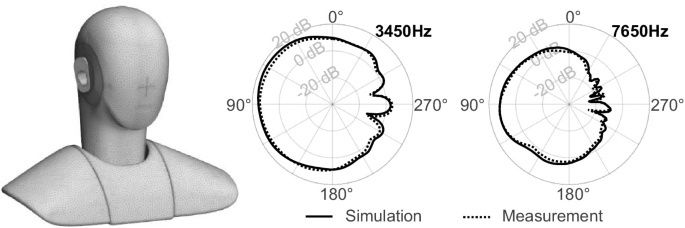
Generic HRTFs are useful, especially when a production must reach a large audience with no individual measurements. However, a mismatch between the modeled anatomy and the listener can weaken elevation, blur front-back distinctions, or create the impression that a source is inside the head rather than located in the surrounding room. Headphone placement, ear-cup leakage, playback equalization, and listening posture add further variables. A reliable mix should therefore be tested with several listeners and playback systems rather than judged from one preferred setup alone.
Personalization is becoming more practical. The research described in recent HRTF individualization work combines sparse measurements with a generative model to estimate a listener-specific filter without requiring a long laboratory session. Such methods are promising, but they do not remove the need for validation. A useful personalized model should improve localization in listening tests, preserve tonal balance, and remain stable when the listener moves or changes headphones.
- Anatomical measurements: Head width, shoulder width, torso dimensions, and pinna geometry influence the filter.
- Measurement quality: Microphone placement, room reflections, calibration, and source positioning affect the captured data.
- Headphone response: The playback device can exaggerate or hide the intended spectral cues.
- Listener adaptation: The auditory system can learn modified cues, but adaptation requires consistent exposure and practice.
- Head movement: Dynamic rotation supplies information that a static binaural rendering may lack.
Translating Biological Acoustics into Practical Spatial Mixing
Biological principles become useful only when they influence decisions early in the workflow. Binaural monitoring should not be reserved for a final export check, particularly when the audience is likely to listen through headphones. Early monitoring reveals localization drift, weak height perception, front-back confusion, excessive internalization, and unstable loudness before those problems become embedded in arrangement and automation. A balanced workflow can alternate between binaural headphones, stereo checks, and immersive loudspeaker monitoring, provided each stage has a clear purpose.
Object-based production also requires careful control of masking and phase. Two objects occupying the same critical bands can obscure one another even when their nominal positions differ. Excessive decorrelation may make a scene feel wide but unstable, while correlated signals can collapse toward the center or produce comb filtering when reproduced through speakers. Practical training in immersive production, such as that described in advanced audio curricula covering object-based and multi-format delivery, reinforces the need to judge both the artistic field and the technical translation.
- Check ITD-sensitive transients for accidental timing offsets and phase damage.
- Use ILD and spectral shaping together, rather than forcing every position through broadband level changes.
- Keep important dialogue and navigation cues clear within their critical bands.
- Compare binaural and speaker-array renders at matched, calibrated loudness.
- Test consumer headphones with different ear-cup designs, seal conditions, and frequency responses.
- Preserve a dependable stereo interpretation for listeners who do not use an immersive decoder.
Calibrate Your Production Ear for the 3D Landscape
The most reliable spatial mixes treat the listener’s anatomy as part of the signal path. Timing differences establish lateral position, head shadow supports high-frequency direction, pinna filtering supplies elevation and front-back evidence, and reverberation supplies distance and environment. These cues work as a coordinated system, so a technically impressive renderer can still fail if the sound design contradicts the acoustic scene.
Build spatial judgment through repeatable checks rather than intuition alone. Keep monitoring levels consistent, verify headphone placement, compare near and far sources, and use head movement when evaluating elevation and front-back stability. The following field checklist provides a practical starting point:
- Calibrate the monitoring chain and document the headphones or speakers used for critical decisions.
- Place essential sources with timing, level, and spectral cues that agree rather than relying on panning alone.
- Inspect masking in critical bands before adding width, height, or heavy reverberation.
- Check the binaural render early, then compare it with stereo and loudspeaker versions.
- Test front, rear, overhead, and low sources with several listeners when possible.
- Revisit the mix after small head movements, because a stable 3D field should remain coherent as the listener changes orientation.
Three-dimensional audio is best understood as deliberate acoustic architecture. The tools may be digital, but the evidence they manipulate is physical and biological. When creators learn to shape arrival time, level, spectral reflections, and room response with the same discipline that the auditory system applies in everyday navigation, immersive sound becomes less of a computational novelty and more of a controlled, believable landscape.