Entering the Bronze Ecosystem
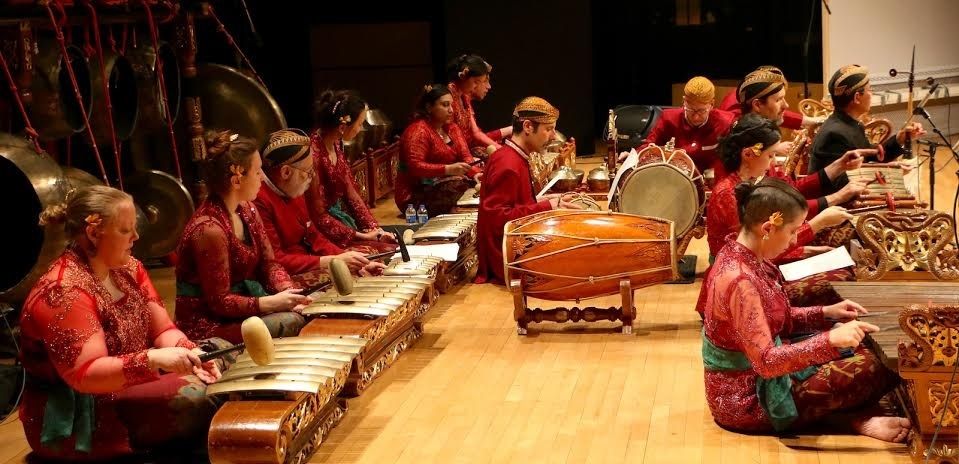
Approach a gamelan ensemble as a living acoustic environment rather than a collection of instruments. In Java and Bali, the sound is built from gongs, metallophones, drums, voices, flutes, and other instruments whose roles are connected through repeating cycles. A player does not simply present an isolated line. Each stroke occupies a carefully negotiated position inside a larger structure, and the musical result depends on how every layer supports the others.
This requires a useful adjustment for Western listeners and travelers. Solo virtuosity, individual projection, and a fixed downbeat are not always the primary measures of achievement. In many gamelan settings, the highest skill lies in hearing the ensemble accurately, entering at the right density, shaping energy without overpowering neighboring parts, and preserving the shared cycle. Before attending a rehearsal, ceremony, or performance, listen for relationships rather than ranking instruments. Treat the sound as a terrain with landmarks, paths, and changing levels of activity.
Core Instrumentation and Structural Foundations
The central terrain is dominated by bronze percussion. Large hanging gongs establish the widest structural points, while smaller gong chimes and horizontal kettle gongs fill intermediate positions. Metallophones such as the saron articulate the core melodic framework, often called the balungan, while the gender uses suspended keys and a more elaborate playing technique to create ornamented, flowing elaboration. The kendang, or lead drum, coordinates tempo, transitions, accents, and changes in performance character.
Bronze is not merely a durable material chosen for convenience. Forged and cast metal produces a powerful, sustained, and complex tone whose partials contribute to the shimmering character of the ensemble. Paired instruments may be tuned slightly apart, creating ombak, an audible beat or undulation that gives the sound movement. Because the instruments are maintained as a set, replacement with an instrument from another ensemble can disrupt both pitch relationships and timbral balance. For a broader survey of regional differences, consult this authoritative overview of traditional gamelan orchestras.
| Instrument family | Typical structural function | What to listen for |
|---|---|---|
| Gong ageng and large gongs | Mark major cycle points | Deep resonance that confirms arrival and closure |
| Saron metallophones | State or outline the balungan | Compact melodic tones forming the audible skeleton |
| Gender and related metallophones | Elaborate, decorate, and connect tones | Flowing patterns between the framework notes |
| Kendang | Guide tempo, transitions, and expressive energy | Signals that redirect the ensemble without a visual conductor |
| Gong chimes and kettle gongs | Fill subdivisions and articulate rhythmic detail | Intermediate punctuation and interlocking activity |
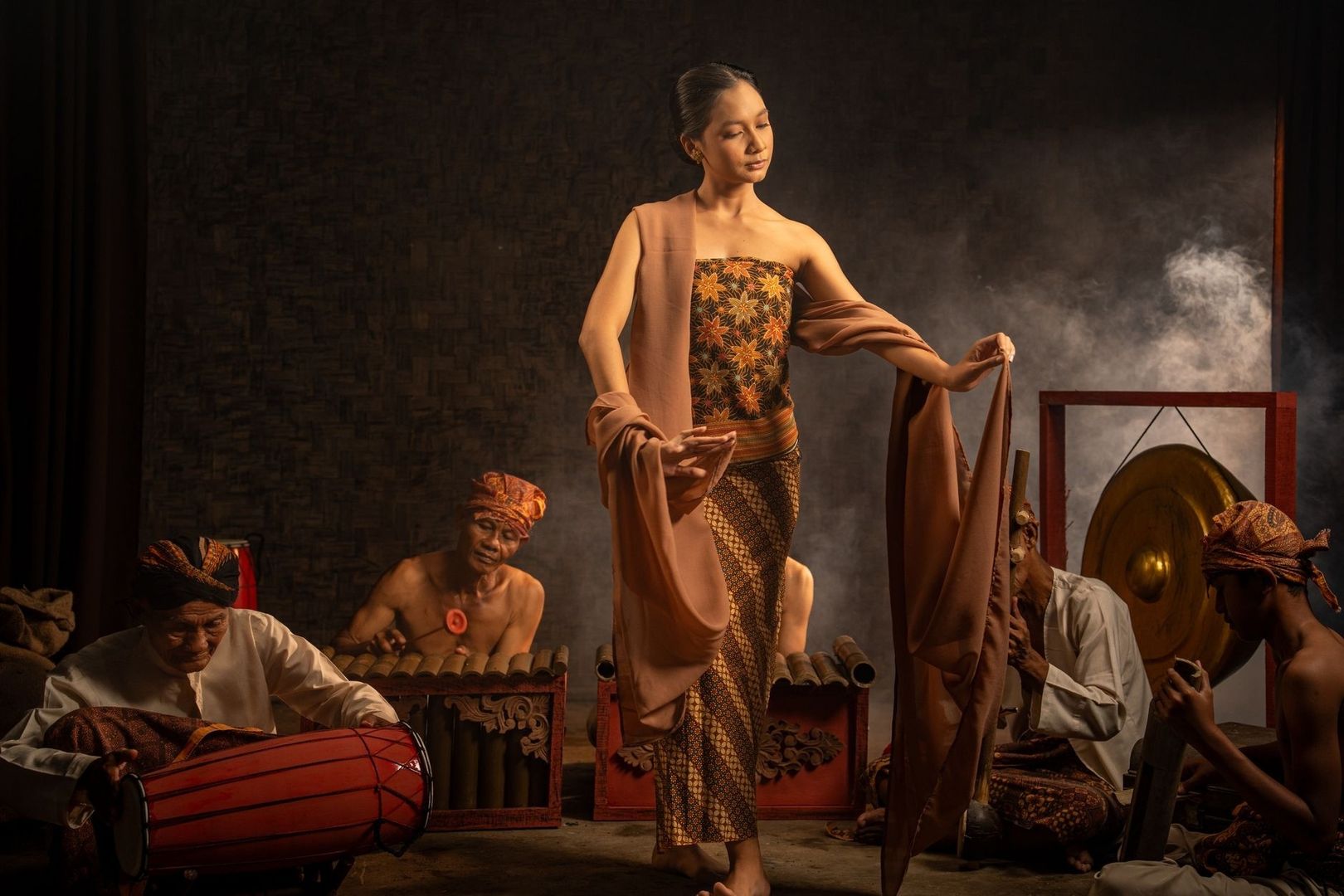
Function also depends on setting. A court-derived Javanese performance may favor spaciousness, restraint, and finely controlled density, while Balinese ensembles are often associated with faster, sharper contrasts and highly coordinated bursts of activity. Gamelan accompanies ceremonies, dances, shadow-puppet theater, and religious occasions, so an instrument”s meaning cannot be separated entirely from the event around it. In field conditions, watch the social space as carefully as the musicians. Seating, movement, ritual objects, and audience behavior can indicate when the music is functioning as entertainment, accompaniment, offering, or ceremonial support.
Navigating the Colotomic Architecture
Colotomic architecture is the system by which recurring gong strokes divide musical time into nested cycles. The largest gong may mark the end of a gongan, while smaller instruments identify internal divisions. Instead of relying on a continuous bar line or a strongly emphasized first beat, the listener learns to recognize a cycle through its pattern of punctuation. The result resembles a route with major trail markers, intermediate junctions, and smaller changes in surface underfoot.
The gong ageng is the gravitational center of this design. Its low, prolonged resonance does more than provide a dramatic accent. It confirms a structural return and allows performers to orient themselves within the cycle. Between gong strokes, the ensemble can expand, contract, thin out, or intensify. This is why a performance may feel slower or faster without a straightforward change in pulse. The changing relationship between time, silence, density, and melodic activity is central to what is often discussed as irama. For a detailed treatment of these processes, consult this study of Javanese temporal flow and irama theory.
Use the following listening protocol when the texture first seems difficult to follow:
- Locate the deepest gong. Do not chase every melodic note. Wait for the recurring resonance that seems to close or reset the largest phrase.
- Count the smaller punctuation points between those large gong strokes. These may be made by other gongs or gong-chime instruments and will reveal the cycle”s internal map.
- Follow the saron or another central metallophone for the balungan. Treat this line as a route map, not necessarily as the most decorative or prominent sound.
- Listen to the kendang for changes in direction. Drum signals may introduce transitions, adjust energy, or coordinate the ensemble without a conductor standing in front.
- Notice density rather than only tempo. A passage can become more crowded while the underlying cycle remains stable, or it can open into silence while retaining the same structural path.
Experienced listeners eventually hold several scales of time at once. The large gong cycle provides orientation, internal punctuation provides navigation, and short melodic or rhythmic patterns provide immediate detail. Do not expect instant comprehension. A practical field exercise is to record a short excerpt where permitted, mark each gong ageng stroke, and replay the passage while tapping only the major cycle. Once that map is secure, add the intermediate markers and finally the elaborating parts.
Kotekan Mechanics and Interlocking Rhythms
Balinese kotekan demonstrates the communal logic of gamelan with unusual clarity. A rapid composite pattern is divided between complementary parts, commonly described as polos and sangsih. Polos generally carries the lower or more directly aligned portion of the pattern, while sangsih supplies the upper or contrasting portion. Neither part is complete on its own. When the two performers coordinate precisely, the listener hears a single fast-moving melodic or rhythmic stream.
This arrangement changes the practical meaning of accuracy. Each performer must know not only the notes being played, but also the gaps left for the partner. A premature attack can erase the intended alternation; excessive force can make one half dominate the composite line. The technique therefore demands anticipation, restraint, and close attention to shared timing. It also illustrates why describing gamelan as a set of percussion instruments is insufficient. The meaningful unit is often the relationship between players.
- Start with the skeleton. Reduce the pattern to its main arrival points before attempting the rapid interlocking version.
- Practice the rests. Silent spaces are active parts of the design. Count them as carefully as the struck notes.
- Use a partner before increasing speed. A stable, slow exchange develops shared timing more reliably than solo acceleration.
- Keep the stroke economical. Light, controlled attacks preserve clarity and leave acoustic room for the complementary part.
- Train the ear away from visual cues. Practice responding to sound, breath, and the partner”s timing rather than waiting for a conductor”s gesture.
For field study, begin by clapping only the polos part while a recording supplies the complete texture. Then switch to the sangsih part. The final exercise is to speak or clap the composite rhythm while hearing how the two lines lock together. In ensemble practice, agree on a shared starting breath and a clear method for recovering after an error. A missed note need not become a collapse if both players return to a known structural point. This is communal syncopation in practical terms: individual freedom exists, but it is bounded by responsibility to the shared pattern.
The Tuning Landscape of Slendro and Pelog
Slendro and pelog are the principal tuning systems associated with Indonesian gamelan, but neither should be treated as a single standardized scale comparable to a universal Western pitch system. Slendro is commonly described as a five-tone system, while pelog is commonly described as a seven-tone system. Actual ensembles vary in pitch placement, interval size, octave span, register, and instrumental response. Tone names and theoretical descriptions help organize practice, but they do not eliminate the distinct identity of each ensemble.
The acoustic result is shaped by both tuning and instrument construction. Metallophones are inharmonic, meaning their partials do not necessarily align with the simple integer relationships expected from an ideal string or pipe. Pseudo-octaves may be stretched, and the interval between corresponding tones can differ from strict octave equivalence. Paired instruments may be tuned close together rather than identically, producing ombak, the beating shimmer that animates sustained passages. This effect is not an accidental defect. It is part of the ensemble”s intended sonic character.
| Feature | Slendro | Pelog |
|---|---|---|
| Common description | Five-tone system | Seven-tone system |
| Interval impression | Often relatively even in broad outline, though actual sets vary | More visibly unequal, with contrasting interval sizes |
| Pitch standard | No universal fixed frequency set | No universal fixed frequency set |
| Octave relationship | May be stretched or otherwise non-equivalent in practice | May also use a wider pseudo-octave and variable register relationships |
| Practical approach | Learn the specific ensemble”s pitch world | Learn the specific ensemble”s pitch world and selected tones |
Do not tune a borrowed instrument to a digital equal-temperament reference and assume the ensemble has been corrected. The set is a family, and its identity lies in the relationships among its instruments. That principle matters for sound designers as well as travelers. Sampling one metallophone and forcing it into a standardized scale may preserve the attack but lose the beating, inharmonicity, register relationships, and collective color that make the source recognizable. Capture several instruments when possible, document the ensemble and context, and preserve the natural pitch relationships before processing.
Carrying Communal Awareness Beyond the Performance
A useful field listener leaves a gamelan performance with a different sense of musical attention. Start with the large landmarks, then move toward the internal details. Identify the gong cycle, track the balungan, observe how the kendang redirects energy, and notice when density changes without assuming that tempo alone explains the transformation. This method works in a formal concert, a rehearsal, a dance accompaniment, or a ceremonial setting, although the correct behavior and access conditions will differ.
The deeper lesson is practical rather than abstract. Gamelan turns collaboration into a form of disciplined mutual care, often connected with the Indonesian idea of gotong royong, or collective cooperation. The individual part matters precisely because it supports something larger. That responsibility should shape how living traditions are encountered and supported.
- Ask permission before recording, photographing, touching instruments, or entering a rehearsal area.
- Follow local guidance during ceremonies, especially regarding seating, movement, dress, and moments of silence.
- Support musicians, teachers, cultural organizations, and community events through appropriate attendance or contributions.
- Do not treat regional differences as a hierarchy. Javanese, Balinese, Sundanese, and other practices have distinct histories and performance priorities.
- When adapting gamelan ideas in Western composition or sound design, credit the tradition, avoid flattening it into a generic “exotic” effect, and preserve context wherever possible.
Listen for the moment when a complex ensemble stops sounding like many separate actions and becomes one coordinated field. That moment is the practical key to gamelan. Its architecture is built from cycles, tuned relationships, interlocking gaps, and shared restraint. Once those elements become audible, the music is no longer an impenetrable wall of percussion. It becomes a navigable landscape, and the listener can move through it with patience, accuracy, and respect.